DEFINITION
What Is a High-Trust Business™?
When prospects buy the person before they buy the service.
By Stuart Bell
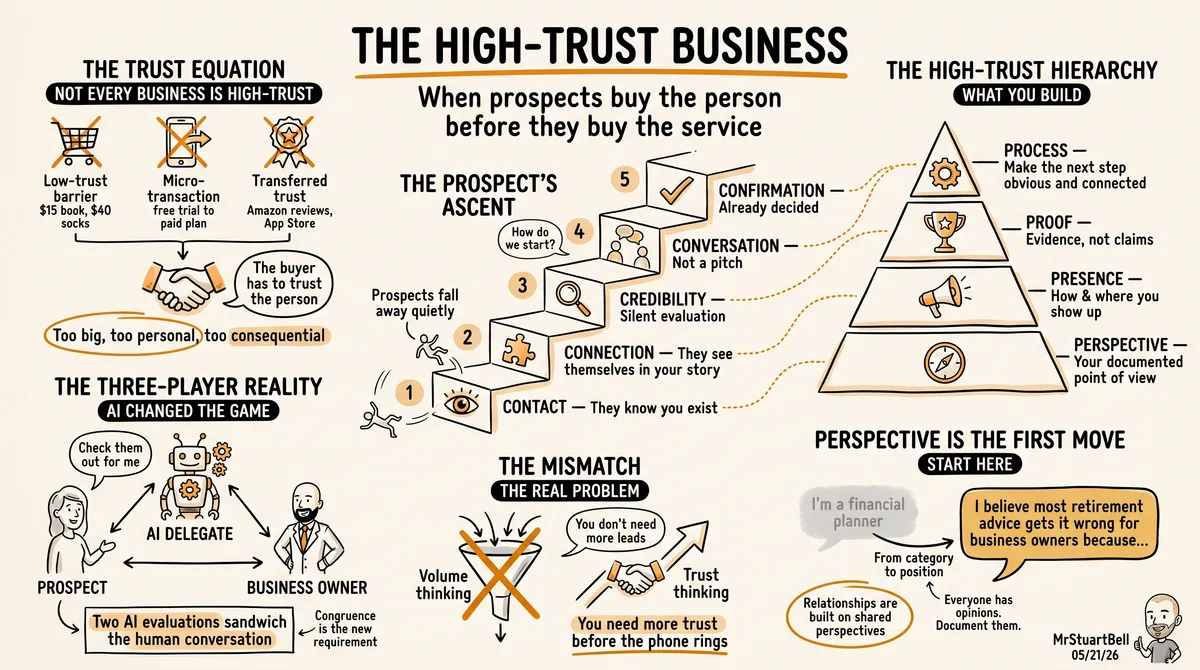
A High-Trust Business™ is one where prospects want to feel a connection with a person before they buy. A business where you've always differentiated yourself through conversation.
The term isn't about prestige, credentials, or professional standing. It's about specific purchase behaviors and the relationship between you and your prospects.
Commitments are based on relationships, not transactions. The buyer can't evaluate the product without evaluating the person. The conversation is the relationship taking shape.
That requirement changes how the business has to be marketed, how clients decide, and how trust gets built. For decades this type of business has been poorly defined, and the marketing advice aimed at these businesses was built for a different kind of buying behavior.
What's also changed is who they're talking to before they call you. Their AI tools have become part of the decision, and most high-trust business owners haven't accounted for it.
Incoming trust, not internal trust
Search "high-trust business" today and almost everything you'll find is about Internal Trust. Team culture. Employee engagement. Organizational trust. That work matters, and organizations like Great Place to Work and others have spent two decades helping companies thrive internally. The phrase "high-trust" has been applied to societies, organizations, and industries, each time describing a different dimension of trust: cultural cohesion, internal culture, or the nature of the service being delivered.
But as business owners, we need to understand Incoming Trust. The trust you have to engender in prospects before they'll speak to you and keep building once they do.
This article is about that incoming trust.
Why this category exists
For twenty years, high-trust businesses have been told to market like transactional businesses.
More followers. More content. More leads. More funnels. More ads. The advice came from Amazon, from Shopify, from the SaaS growth playbook, and trickled down to every marketing agency, every course, every LinkedIn expert.
The underlying assumption was always the same: cast a wider net, optimize the funnel, convert a percentage of the people ready to buy, repeat.
That logic works if the purchase is low-stakes and reversible. It doesn't work if the purchase requires more of a commitment and people become buyers over time.
Volume is a constant game of filling the funnel and commoditizing your service. What high-trust businesses actually need is the right number of motivated prospects, predisposed to trust you, and believing you're the person for the job.
The metric that matters is trust before the phone rings.
The metric that matters is trust before the phone rings.
The forgiveness is gone
For a long time, high-trust business owners could win on reputation, word of mouth, and being present in their community, because most of their competitors did even less. The bar was low. The baseline was quiet. A decent website, some referrals, and showing up at the right local event was enough to stand out. Any mismatch in messaging was forgiven.
That time is gone.
The cost of engagement has collapsed to near zero. Every competitor in your market can now produce blog posts, email sequences, social media content, and landing pages at a pace that was unthinkable just three years ago.
The baseline noise is louder, and silence now reads as absence. But the penalty for having no clear perspective, no visible share of voice, no documented point of view, is just as severe. When the same generic content is everywhere, trust is established through opinion.
Owning your piece of the conversation
Owning your piece of the conversation is no longer a nice-to-have. Not because you need to match your competitors' volume, but because your prospects are so flooded with information already, volume alone no longer wins. If you don't give them something distinct to hold onto, you get lost in the wash.
The high-trust business that wins isn't the loudest. It's the one with the clearest perspective, the most visible proof, and the most obvious process for getting results.
The game hasn't changed. The stakes for playing it properly have.
The high-trust business that wins isn't the loudest. It's the one with the clearest perspective, the most visible proof, and the most obvious process for getting results.
The trust equation
Every business runs on trust, but not every business is High-Trust.
Many have relationships with potential clients that allow them to solve the trust problem in a different way.
Low trust barrier businesses
The purchase is small, reversible, or low-stakes enough that the buyer doesn't need to build much trust before committing. A $15 book. A $40 pair of socks. A $9 software subscription. If it goes wrong, nothing catastrophic happens. The buyer's downside is small enough that they can take a risk.
This is most of e-commerce and most impulse retail.
Micro-transaction on-ramp businesses
The buyer doesn't need to trust the whole business before the first transaction. They trust it enough to try the smallest version. The free trial leads to the paid plan. The first Uber leads to hundreds of rides. The coffee shop they walked into once becomes the coffee shop they go to every morning.
Trust gets built in small increments, each purchase earning the right to the next. Much of SaaS works this way.
Transferred Trust businesses
Someone else's trust gets passed along so the buyer doesn't necessarily build a relationship with the seller from scratch. The reviews on Amazon are a trust system. The curation of the Apple App Store is a trust system. A strong personal referral is a trust system. A well-known platform puts its brand behind the unknown seller underneath.
The buyer isn't trusting the seller directly. They're trusting the mechanism that surfaced the seller to them.
Why none of these work for a High-Trust Business™
A High-Trust Business requires a different approach.
The transaction is too big, too personal, or too consequential for a low trust barrier. There's no smaller version the buyer can try first. And while referrals and platforms can help with credibility, they can't close the deal on their own.
At some point, the buyer still has to sit across from a human and make up their mind.
That's why the conversation is structural, not optional.
The question isn't what sector you're in. It's what the buyer actually needs before they'll commit.
What this looks like from the inside
If you run a high-trust business, much of this will sound familiar.
You get referrals, but you can't control the flow. You know you should be doing more marketing, but nothing you've tried seems to fit. You tried an agency, or ads, or social media, and it didn't work for you. Your best clients already trust you before they walk in the door, and you'd love to figure out how to create more of those, but you don't know where to start.
You don't want to compete on price. You feel like the best-kept secret in your market. Leads come in, but there aren't enough of the right people.
None of that is a personal failure. It's the High-Trust tell.
Those frustrations are what the category looks like from the inside, and you've been experiencing them because the marketing advice you've been given was built for a different kind of business.
How high-trust businesses win
The standard marketing funnel is a filter. It pours leads in at the top, drops them through stages, and a percentage comes out at the bottom. That model works for something commodified. It's the wrong model for anything that needs a conversation.
High-trust purchases work the other way around. The prospect doesn't get filtered down through volume. They ascend through trust, through what I call the High-Trust Ascent™.
A traditional funnel assumes every lead is equivalent and momentum is toward working together. That's why there's such a focus on volume. An ascent assumes momentum is against you. The work is trust-building at each stage, so the prospect's own choice gets reinforced as they climb.
I first heard the idea of the inverted funnel from Flint McGlaughlin. In his model of Listen, Attract, Converse, Nurture, a prospect's tendency is to fall out at any point.
In the High-Trust Business™ model, potential clients ascend in a similar way. They never skip a stage, and the stages you are weakest in have the greatest risk.
Worse still, these issues are often invisible to you. Prospects who fall out in those stages don't usually call to explain why.
The five C's of a high-trust purchase
The ascent has five stages, called the High-Trust Ascent™. Each is a step the prospect has to clear before they reach the next, and each is a point where they can quietly fall away. Each is a chance to remove the friction that would have stalled the climb.
Step 1. People need to know you exist, and have a reason to engage. If you're invisible, the ascent never gets started.
They recognize you can help with their situation. Your service fits their problem. They see themselves as the kind of person you work with. They make a connection between you and their outcome.
They look for confirmation signals before they pick up the phone. Reviews, case studies, content, what you've written, who's written about you, who's recommended you. Most silent evaluation happens here, and businesses that get eliminated at this stage never even know they were being considered.
The first real contact. A call, a meeting, a review session. High-trust businesses have always lived here and always been strong here. If the earlier stages have stacked properly, the conversation isn't a pitch. Instead, prospects arrive ready to confirm a decision they've mostly already made, not to figure out what you do.
The final yes. The earlier stages gave your prospect everything they needed to get to the point of commitment. Confirmation is the moment they make it real, often by checking their decision against the people, and increasingly the AI tools, they trust most.
What this looks like in practice
You know your prospects listen to a handful of industry podcasts. You've worked out what you actually believe about the problem they're facing, and how it's different from what most people in your category say. So you reach out and get yourself booked as a guest. Contact.
A prospect hears the episode. They've started thinking about the problem, but they're nowhere near ready for a meeting. They're just listening.
At the end of the show, you offer a short report that goes deeper on the one thing you said that stood out to them. They follow the link, download it, and read it that evening. Connection. You haven't met. They haven't responded to anything. But they're now reading your perspective in their own time, in their own words.
Months pass. They don't act on it.
Then they hear a peer at a dinner mention the same problem you write about. It reminds them. They dig out your report, read it again, follow you on LinkedIn, and click through to your site. Everything they see matches what they read months ago. The articles you've written, the case studies, the way you describe the problem. It's congruent. They keep recognizing themselves in what you're saying. Credibility.
They follow a link from your site to a short scorecard. It asks structured questions about their situation, and gives them a personalized result. By the time they've seen the result, they've already decided. They book a call. Conversation.
By the time they're on that call, they're not asking "what do you do?" They're asking "how do we start?" Confirmation.
Every stage did work. Not because they happened to find you. Because you built each layer of the Hierarchy so that when they were ready, you were there. Perspective on the podcast. Presence across the channels they checked. Proof in the case studies and the consistent voice. Process in the report and the scorecard that made each next step obvious.
What you need to build as a high-trust business owner
The 5 C's describe what the prospect goes through. Let's look at it from your perspective. What do you need to build to support this ascension?
The High-Trust Hierarchy™ is four layers, each building on the one below it to build trust.
The High-Trust Hierarchy™
Your documented point of view on your clients' problem, who you serve, and why you're different. Not a tagline. Not a positioning statement. A genuine opinion you can defend and your audience resonates with.
Perspective is what tells a prospect you've actually thought about their situation. It's the difference between "I'm a financial planner" and "I'm a financial planner who believes most retirement advice is designed for W-2 employees and gets it wrong for business owners with a concentrated illiquid asset." The first is a category. The second is a position. One is forgettable. One creates a reason to keep reading.
This is the foundation, and it's where most high-trust businesses fall down. They skip it because it feels soft, or because they assume their work speaks for itself, or because taking a position feels risky in a category where "everyone needs us." But without a clear perspective, the other three layers have nothing to point at.
Presence becomes generic. Proof has no specific claim to demonstrate. Process has no reason to exist beyond convenience. The whole Hierarchy stays beneath the surface, and your prospect can't tell what makes you different from the firm down the road.
Once you know who you're for, you can decide where to show up. Your website, your posts and articles, your Google Business Profile, your professional listings, your social presence, your podcast appearances, your PR. All of it reflects the perspective underneath.
Presence without perspective is noise. Presence, in the places your prospects are already looking, with perspective is the reason they start to connect with you.
Evidence your perspective and process deliver. Content, case studies, testimonials, reviews, results, named clients, third-party coverage.
Proof is stronger when it follows perspective, because the proof is demonstrating a specific claim, not just "we're good at what we do." A case study that shows you solved the exact problem you said you solve, in the way you described it, based around a client that mirrors your prospect's experience carries far more weight than a generic happy-client quote.
Connecting to the language they already know and making it as simple as possible for prospects to take the next step without friction getting in the way. Your intake, your diagnostic, your scorecard, your onboarding. Thinking one step ahead of where your prospect is.
Most high-trust businesses have almost nothing here, and it costs them. The prospect who's ready to move forward often doesn't know how, and the friction of figuring it out is enough to stall the decision.
How the layers stack
These four layers map directly to the 5 C's your prospects experience.
Perspective and Presence enable Contact and Connection.
Proof enables Credibility.
Process enables Conversation.
Confirmation is the result of the whole Hierarchy working together.
Most high-trust businesses have Presence (barely) and Proof (inconsistently). Almost none have a strong Perspective or a Process that carries prospects over the line.
The ones that do, don't compete on price.
The AI Accelerator
Prospects no longer start their ascent toward a purchase with a page of Google results. They increasingly start with an AI assistant.
When they've got a problem, they open a chat window, describe it in their own words, and ask for help thinking it through. Their assistant shortlists options, summarizes reviews, and compares approaches based on all they know about their user. By the time the prospect consciously starts "looking for" a provider, their AI companion has already done most of the filtering.
The Three-Player Reality
This is a significant shift. Every high-trust purchase now involves three players, the Prospect, the AI Delegate doing the research on their behalf, and the Business Owner being evaluated.
Contact and Connection happen through AI tools before you know you're being considered. Credibility gets scanned for congruence in seconds, against your website, your reviews, your content, your professional listings, and your social presence.
AI also closes the loop
The pattern continues as prospects loop their tools back in after the conversation too.
They put the proposal into the chat. They ask for a second opinion. They check their instinct against what their AI knows about them, and importantly, can see about you.
If your perspective, presence, and proof are congruent across the board, the AI confirms their decision, and the deal closes with more conviction than any handshake. If they're not aligned, their AI introduces alternatives at the exact moment the prospect was ready to commit.
Conversation is no longer the whole game
Building rapport in conversation still matters to anchor trust. But "win the conversation" is no longer the whole game. That trust needs to be visible across the whole journey. You need to be discoverable at the front of the cycle and confirmable at the back of it.
The trust built in the human conversation is sandwiched between two AI evaluations, and most high-trust business owners haven't yet thought about what that means for what they need to build.
Congruence is the new requirement
Businesses that win from here are the ones whose perspective is distinct, who are present in the right places, who can demonstrate proof before it's asked for, and whose processes are simple and obvious to humans and AI tools. This consistency was optional before because the gaps could be covered by conversation.
Now any gap becomes a break in the prospect's ascent.
Congruence isn't hard for practitioners who actually do what they say they do. It's only hard if there's nothing behind the marketing.
That's your advantage.
Where this leaves you
Forget AI for a moment. The problems start before the robots get involved.
Without a clear perspective on your clients' problem, you look like every other financial planner, dentist, architect, or remodeler in your market. When prospects can't tell you apart from your competition, the decision goes to whoever's cheapest, closest, or showed up first. You lose deals you should have won, and you never find out why.
Perspective was always the first move
The high-trust businesses that have always commanded a premium did the work to be known for something. They decided what they actually believe and who they actually serve. They chose a Perspective. It's the foundation of the High-Trust Hierarchy™. It was always the first move. It just wasn't always obvious how much it mattered.
Now bring AI back in the mix, and the penalty for skipping perspective shows up fast. A human prospect who can't tell you apart might still find you. A referral. A chance conversation. A local event. Lucky breaks happen. AI tools don't have lucky breaks. They look for something distinctive to surface. If you've got nothing differentiated to contribute, you're not on the shortlist. And there are no chance encounters to catch you.
Relationships are built on shared perspectives
High-trust clients are looking to make a connection. These purchases are built on relationships. And relationships are built on shared perspectives.
Saying what every other firm in your category says never made you memorable. Now it makes you invisible. AI models already know the consensus. If your perspective matches what's already out there, the model has no reason to care about you.
The businesses getting surfaced, in AI queries and in real-world conversations, are the high-trust owners who have an opinion about the problems their clients are facing. Not contrarian for the sake of it. Opinionated because they've done the work and built an understanding of the challenges clients face.
Perspective is the foundation too many high-trust businesses still haven't documented. Before another round of ads, another funnel, another LinkedIn post, define what you believe about your clients' problem, get clear about who you serve and who you don't, and identify what you know about helping them that everyone else misses.
Everyone has opinions. Documenting them so they can be seen and discovered before the call ever happens is the step most owners skip.
The opportunity
If you saw yourself in this article, the shift is straightforward.
You're a High-Trust Business™ owner who's been applying transactional marketing to a high-trust problem.
Every frustration you've had with "the marketing didn't work" comes from that mismatch. The advice wasn't wrong in general. It just wasn't built for what you do.
The game you've been playing
Volume is entrepreneur thinking. Trust is business owner thinking.
Stop trying to fill a funnel. Start building the conditions that make the right prospects choose you before the first call.
You don't need more leads. You need more trust before the phone rings.
You don't need more leads. You need more trust before the phone rings.
The category is yours to claim
High-trust businesses thrive on real conversations, with a real person, before the prospect will commit. The decision isn't really about the product. People believe you can do the work. It's about whether they can trust the person delivering it.
You are a High-Trust Business. The question is whether you're going to market like it.
Frequently Asked Questions
What is a High-Trust Business™?
A High-Trust Business is one where prospects need to feel a connection with a person before they buy. The transaction is too big, too personal, or too consequential for a low trust barrier. There's no smaller version the buyer can try first. At some point, the buyer has to sit across from a human and make up their mind.
What are examples of High-Trust Businesses?
Financial advisors, attorneys, architects, remodelers, dentists, medspas, consultants, HVAC companies, and other professional or home service businesses where the client needs to talk to a real person before committing. The defining trait is the purchase behavior, not the industry.
What is the High-Trust Hierarchy™?
The High-Trust Hierarchy is four layers that a business owner builds to earn trust: Perspective (your documented point of view), Presence (where you show up), Proof (evidence your approach works), and Process (making it easy for prospects to take the next step). Each layer supports the one above it.
What are the 5 C's of a high-trust purchase?
The 5 C's describe the buyer's journey in a high-trust purchase: Contact (they know you exist), Connection (they see you can help), Credibility (they look for confirmation signals), Conversation (the first real contact), and Confirmation (the final yes). Prospects ascend through these stages rather than being filtered down through a funnel.
How does AI affect High-Trust Businesses?
Every high-trust purchase now involves three players: the prospect, their AI delegate doing research on their behalf, and the business owner being evaluated. AI tools shortlist options and compare approaches before the prospect consciously starts looking. After the conversation, prospects loop their AI back in to check their instinct. The trust built in the human conversation is sandwiched between two AI evaluations.
Is a High-Trust Business™ the same as a High-Trust Industry?
No. A High-Trust Industry is defined by the sector (legal, financial, medical). A High-Trust Business is defined by the purchase behavior: the prospect needs a conversation with a real person before they'll commit. That's a different lens. A remodeler isn't in a traditionally 'high-trust industry,' but the purchase is absolutely high-trust. A SaaS company selling to enterprises might be in tech, but if the deal closes on a call, it's a High-Trust Business. The defining trait is how the buyer decides, not what industry the business belongs to.
Go Deeper
THE BOOK
A Brutally Honest Guide to Marketing Your High-Trust Business™
The tactical implementation, layer by layer
MORE WRITING
High-Trust Business on MrStuartBell.com
More writing on everything High-Trust
HIERARCHY
The High-Trust Hierarchy™
The four layers that earn trust
ASCENT
The High-Trust Ascent™
The five stages every prospect climbs